

CSR for data centers: environment, local area and ethics at Thésée Datacenter
At Thésée Datacenter, corporate social responsibility is built on measured targets and accessible documents. It covers energy, carbon, waste, local roots and ethics.
This page presents each commitment together with its evidence, in connection with our company.

What is CSR?
Since 2011, Europe has defined corporate social responsibility (CSR). The European Commission describes it as “the responsibility of enterprises for their impacts on society”. A committed company builds its environmental, social and economic impacts into its strategy. It explains them to its customers, employees, neighbours, suppliers and shareholders.
CSR is often structured around three dimensions: environmental, social and economic. Published in 2010, the ISO 26000 standard describes its scope. It provides guidelines, without granting any certification. It sets out seven principles.
- Accountability: the company explains the effects of its activities.
- Transparency: it communicates clearly about its choices and its actions.
- Ethical behaviour: it bases its practices on honesty, fairness and integrity.
- Stakeholders: it identifies their interests and takes their expectations into account.
- Legality: it complies with the law in force.
- International standards: it uses them as a reference when local law offers less protection.
- Human rights: it respects them across all of its activities.
CSR for data centers: four challenges specific to our business
A data center runs continuously. The servers consume electricity, as do the systems that cool them. Its activity uses land and materials, and changes local life.
- Energy: PUE (Power Usage Effectiveness) measures the ratio between the site's total energy and the energy used by the IT equipment.
- Water: some cooling systems use it, which calls for water-efficiency targets.
- Carbon: emissions come from purchased electricity, construction work and equipment.
- Local area: noise, land footprint and local benefits influence how the site is accepted.
The legal framework also covers these topics. Directive (EU) 2023/1791 on energy efficiency applies to data centers from 500 kW of IT capacity upwards. Every year, they report their indicators to a European database. Delegated Regulation (EU) 2024/1364 sets out this data in detail: energy, water, renewables, reused heat.
Measure our results: quantified and sourced commitments
Our commitments come from the design of our sites, from a European framework or from our carbon footprint. The table shows their type and their source.
Indirect free cooling and carbon trajectory
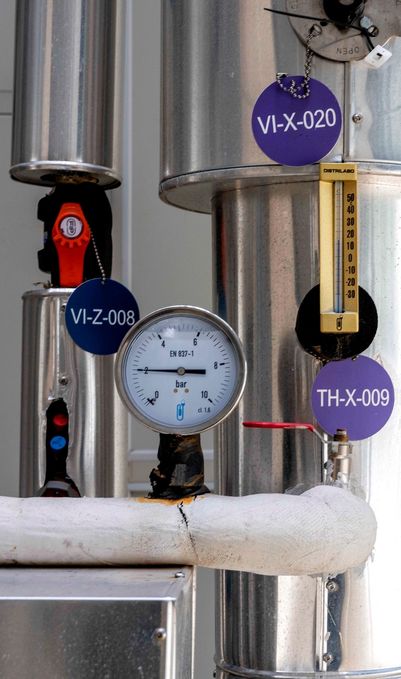
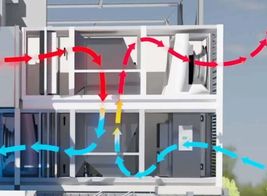
At the Aubergenville campus (TDC01), indirect free cooling cools the rooms with outside air, without direct contact. Adiabatic evaporation completes this process. The chillers only come into play during hot periods. Our membership of the Climate Neutral Data Centre Pact frames our PUE and water targets. We also take part in the European Code of Conduct on Data Centre Energy Efficiency. Our carbon trajectory follows the recommendations of the SBTi (Science Based Targets initiative).

Circular economy: zero waste on electrical equipment
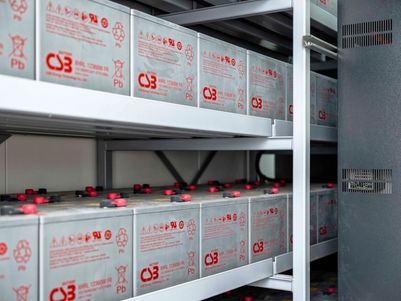
We apply a zero-waste policy to electrical materials. Cages and electrical equipment are reused. This approach limits toxic or non-recyclable waste. The hosted servers remain the property of our customers, who organise their end of life.
Local area and biodiversity: a campus integrated into its environment
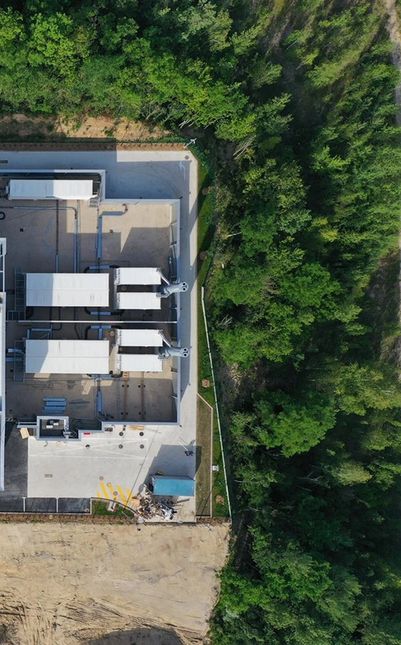
The Aubergenville campus is located in a sparsely built-up area, in order to reduce operational nuisance. Beehives installed on site produce honey. Sheep also maintain the green spaces.
A district heating project plans to recover the waste heat from our IT rooms. The servers generate this heat, which would otherwise be lost. We are also aiming for ISO 14001 certification, dedicated to environmental management, in the second half of 2026.

Governance and ethics: published rules
Updated in 2026, our code of conduct and ethics sets out the principles followed by our employees. The sovereign data center page presents our commitments in the face of extraterritorial laws.
Available to download: our carbon footprint, our code of conduct and ethics and our ISO 50001 certificate.
See also
Frequently asked questions about our CSR approach
Find the answers to the key questions about CSR applied to data centers: pillars, ISO 26000 principles, PUE and regulatory obligations.
What are the 3 pillars of CSR?
CSR rests on three pillars: the environment, social issues and the economy. It combines economic performance with a reduction in environmental impacts.
What are the 7 principles of CSR?
The ISO 26000 standard sets out seven principles. It cites accountability, transparency, ethical behaviour and respect for stakeholder interests. It adds legality, international norms of behaviour and human rights.
What is Thésée Datacenter's PUE?
The Aubergenville campus is designed for a PUE of 1.2 thanks to indirect free cooling and adiabatic evaporation. Our membership of the Climate Neutral Data Centre Pact sets a PUE of 1.3 and 0.4 litre of water per kWh.
What is the environmental impact of a data center?
It comes mainly from the electricity consumed and from the water sometimes needed for cooling. Construction, equipment and land footprint add further impacts.
Is a data center CSR approach mandatory?
A CSR approach remains a voluntary choice. However, data centers from 500 kW upwards must report their energy indicators every year. This requirement comes from the 2023 European directive on energy efficiency.
Preparing a tender or your reporting?
Request our energy indicators and our CSR documents: PUE, water consumption, carbon footprint and certificates.